
By: Heather Eckner, Director of Statewide Education, Autism Alliance of Michigan
January 19, 2026
Hope is Not an Accident
Today, the Autism Alliance of Michigan is closed in observance of Dr. Martin Luther King Jr. Day. I am using this pause not as a break from the work, but as a moment to reflect on it—especially following an inspiring convening of PACE (Policy, Advocacy, Community Engagement) last Friday, January 16, 2026, hosted by KConnect in Grand Rapids.
The gathering opened with a powerful reflection on hope.
Is hope something left to chance?
Or is it something we use—to plan, to organize, to change?
The message was clear: hope cannot become real if we don’t take action together. Hope requires community. It requires gathering with others who refuse to surrender their belief in possibility, even when the conditions suggest otherwise. In moments like this—when tools feel as though they are being stripped from the toolbox—we must continue to affirm the intrinsic value of every person and resist the dangerous lie that outcomes are already predetermined.
Historical context matters. Not because it reassures us that progress is inevitable, but because it teaches us how progress has actually been made. Advocacy works—even when it feels slow, fragile, or under attack.
Dr. Chris Cadogan of KConnect framed Dr. King’s Where Do We Go From Here: Chaos or Community?—written in 1968, near the end of Dr. King’s life—as something like “notes from the field.” Not theory. Not nostalgia. But lived analysis forged in the middle of struggle. Dr. King understood that there are inflection points across space and time—and that while we are often held captive by the urgency of the present moment, we are also capable of rising above it.
Several themes from the convening echoed loudly for me, especially as they intersect with Dr. King’s work and the present-day civil and disability rights movements:
First, backlash is not a sign of failure. It is often evidence of progress.
Backlash signals that entrenched systems feel threatened—that something once taken for granted is beginning to shift. It reminds us that resistance often intensifies just before real change becomes unavoidable.
Second, we cannot improvise our way to liberation.
Passion is not a substitute for preparation. Symbolic change is not the same as structural change. Transformation requires a shared vision and a shared strategy.
And third, cynicism is not the enemy of community.
What Dr. Cadogan described as “protective cynicism”—born of shared experience—can be healthy. What we must guard against instead is performative solidarity that signals virtue without building power.
Dr. Shayla Young of KConnect reminded us to honor the foresight of those who lead initiatives that create something out of nothing—often without recognition, resources, or guarantees. And yet, despite all of this, there is a hopeful vision emerging. One rooted not in optimism alone, but in alignment, clarity, and collective action. People powered for change. People supported by real infrastructure, not just inspiration.
Dr. King once urged us to “keep moving from this mountain,” naming four symbolic obstacles that still confront us today: relativism, materialism, segregation, and violence. He called on us to keep faith that “a brighter dawn will soon break the desolate midnight of peoples’ inhumanity.” And in Love in Action, he made something unmistakably clear: advocacy itself is an act of love.
Love grounded in community.
Love made visible through coalition.
Love that shows up, again and again.
It is from this place—this convergence of history, community, and urgent responsibility—that I return to Dr. King’s question from 1968: Where do we go from here—chaos or community?
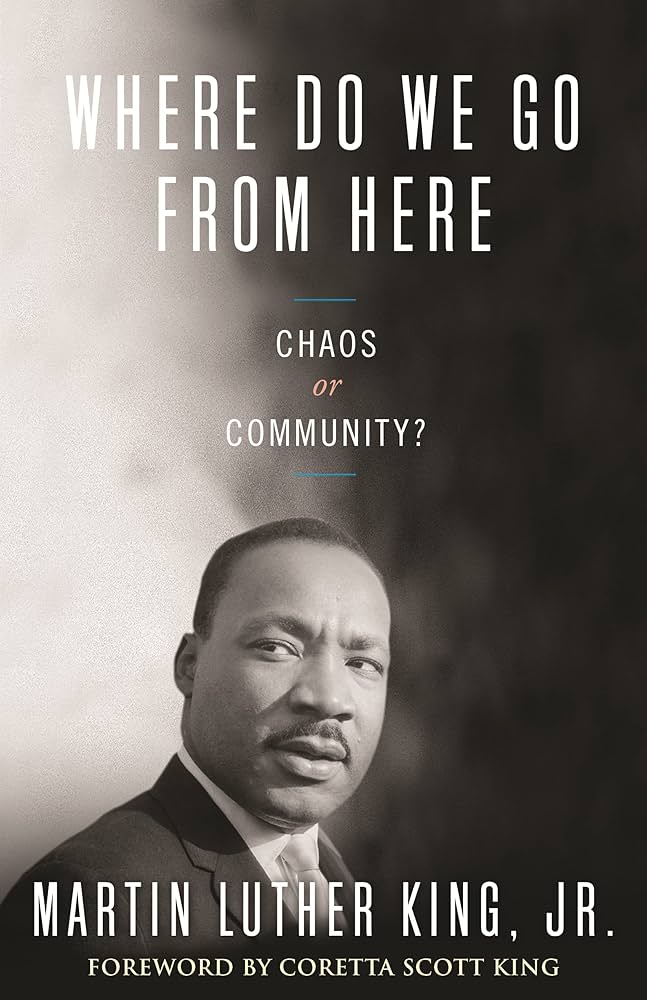
This sentiment still guides those of us committed to justice today. Almost sixty years later, those of us working in disability rights and education justice are still living inside that question.
We are surrounded by words. Reports. Task forces. Agendas. Promises of future reform.
Dr. King warned us about this moment—the “flood of words rather than deeds” that soaks expectations without ever nourishing real change. For families of students with disabilities, this is not theoretical. It shows up as classrooms without supports, laws without enforcement, and systems that congratulate themselves for progress while quietly preserving inequity.
And yet, Dr. King also reminds us: moments like this are golden opportunities. But only if we refuse to mistake programs for power and intention for action.
The Fable of Benevolence
One of Dr. King’s most enduring lessons is also one of the most uncomfortable: the government (made up of institutions and systems) is not inherently benevolent. The belief that justice will be delivered simply because it is deserved is not hope, it is a fable. And worse, it shifts responsibility away from those in power and places it squarely on the shoulders of the marginalized, as though we simply haven’t asked nicely enough.
Disabled people and their families know this story well. We are told to be patient. To trust the process. To wait for the next budget cycle, the next administration, the next study… to “wait and see.” Opportunity, we are told, is coming.
But as Dr. King observed, opportunity never arrives on time for the powerless. It is always postponed. Meanwhile, those with power never lose opportunity—it simply remains available to them. Rights on paper do not deliver themselves. Laws declare; they do not enforce. Deliverance comes only when marginalized communities accumulate enough power to compel action.
Power is Not Given; It is Built
The disability rights movement, like the civil rights movement before it, is not suffering from a lack of moral clarity. We are suffering from a lack of organized power.
Dr. King was explicit: it is immaterial who presents the program; what matters is the ability to make events happen. This is a hard truth for a movement that has often been encouraged to rely on goodwill, expert testimony, or proximity to decision-makers rather than collective strength.
Power is not loudness. Power is the organized capacity to influence outcomes—economic, political, and ideological.
And power does not emerge spontaneously. It must be studied, planned, and built deliberately. When power is real, access follows—and the seat at the table cannot be pulled away.
From Reaction to Strategy
Marginalized communities are often forced into improvisation. When systems fail you daily, there is little leisure for long-term strategy. Dr. King understood this and still insisted on serious reflection. When a new dawn reveals a landscape filled with obstacles, he wrote, the time has come to assess methods, anticipate pitfalls, and organize with intention.
For disability advocates, this means moving beyond reactive advocacy—responding only when harm occurs—and toward coordinated, strategic campaigns that build cumulative strength. It means investing in data, planning, and leadership development. It means returning to steering committees, evaluating what the evidence tells us, and aligning around clear, shared demands.
It also means unlearning what we have been taught about our own capacity.
Disabled people and families have been schooled—repeatedly—to believe in their lack of power. The work of movement-building is, in part, the work of undoing that lie. We must equip ourselves with the science of social change, understanding how pressure is built, how alliances function, and how systems actually move. There will be setbacks. Dr. King never promised otherwise. But he also reminded us that no one knows the true taste of victory without swallowing defeat.
Organization Is the Difference Between Chaos and Community
To attempt radical reform without organization, Dr. King warned, is like trying to sail a boat without a rudder.
Disunity, competition, and fragmentation have long weakened justice movements—including our own. When programs proceed in isolation, at different rates, without coordination, the entire movement suffers. Laws go unenforced. Wins remain symbolic. Families are left to navigate broken systems alone.
What we need instead are organizations—and coalitions—that are trustworthy, disciplined, focused, courageous, and unyielding. Organizations capable of negotiating from strength. Organizations that operate with integrity, efficiency, and shared purpose. This is not about hierarchy for its own sake. It is about building a strong voice that is heard not just in public forums, but in the back rooms where bargaining actually occurs.
Leadership, Alliances, and the Politics We Need
Dr. King was deeply skeptical of “manufactured” leaders—those elevated by the status quo, resourced by it, and ultimately controlled by it. Disability rights has seen this too: representation without accountability, visibility without independence.
The leaders we need are hybrids: they understand politics but are not owned by political machines. They can bargain firmly while operating outside narrow partisanship. They evoke trust, not because they are perfect, but because their unity with the movement is unshakable.
True alliances are not symbolic. They are built on mutual self-interest and shared goals. Anything less is mutual deception. Scrutinizing alliances is not cynicism—it is the work of serious political change. And change will require politics. Dr. King was unequivocal: political action is a source of power, and marginalized groups need it more than anyone. Education without social action is powerless. Social action without education is reckless. We must have both.
The Refusal to Wait
Perhaps Dr. King’s most urgent warning is this: it is the height of naïveté to wait passively for goodwill to materialize.
Justice does not emerge because systems become kinder. It emerges because pressure makes injustice untenable.
Direct action, mass participation—education paired with action—these are not relics of the past. They are the tools that have always reshaped relationships and forced structural change. They are how dignity is claimed, not granted.
We can shrug off this moment. Or we can use it to build something more durable than any single policy win: a movement capable of enforcing the future it demands.
Where do we go from here?
If we choose community over chaos, the path will not be familiar or easy. There is no level road. But there is also no alternative. And the promise—then and now—is vast.
###
About the Autism Alliance of Michigan
The Autism Alliance of Michigan (AAoM) is a 501(c)(3) organization serving as a trusted ally and partner for thousands of families across the state. AAoM’s mission is to lead efforts to raise expectations and expand opportunities for people connected to autism across their lifespan. The organization’s Education team drives initiatives that address systemic barriers to education, focuses on student-centered advocacy, and educates families on related topics – working towards its goal to make Michigan a top 10 state for special education outcomes.
For help finding resources, providers, and information contact our MiNavigators at 877-463-2266 (AAOM) or email at navigator@aaomi.org.
More information about AAoM’s Education pillar can be found at: https://autismallianceofmichigan.org/education-initiatives/.
Learn more about how AAoM is elevating the lived experience, identifying system barriers, and amplifying the voices of parents and students with disabilities connected to the special education system in Michigan to inform our collective advocacy efforts:
-
Special Education Experience (SEE) Survey: Report to the Community
The MI Special Education Finance Reform Blueprint (MI Blueprint) is a statewide initiative to create a better system— one that aligns funding with actual student needs and ensures schools have the resources to deliver. This work, led by Autism Alliance of Michigan with support from Public Sector Consultants, is backed by legislation and bipartisan support, and it’s grounded in data, experience, and input from families, educators, and advocates.
-
Michigan Special Education Finance Reform Blueprint (“MI Blueprint”)
https://autismallianceofmichigan.org/education-initiatives/mi-blueprint/
The Michigan Special Education Benchmark Report is the state’s first unified overview of how Michigan’s public education system is serving students with disabilities. The report brings together statewide indicators on access, quality, and outcomes to establish a transparent baseline for improvement. By highlighting longstanding disparities and identifying the conditions that support meaningful progress, the Benchmark Report offers educators, policymakers, and families a clear set of measures to guide strategic decision-making and track improvement over time. This work is designed to inform system transformation—ensuring that every student with a disability, in every community, has access to the supports and opportunities they need to learn, grow, and thrive.
-
Michigan Special Education Benchmark Report
https://tinyurl.com/MI-Benchmark-Report
Are you a parent, advocate, or attorney dedicated to student-centered advocacy?
Join MiPAAC! mipaac.org/join-mipaac